Music and intentionality
June 26, 2026
I recently listened to an Alex O’Connor podcast in which he and guest Adam Neely discussed the impact “AI”1 is having on music. They sparred across a range of arenas: whether this portends the end of professional musicians (spoiler: no), ethical debates around compensation and fair use, and several more. Check the podcast out, it is worth listening to. While I found their conversation engaging it was, ultimately, unsatisfying. Unsatisfying in regards to the relationship between generative AI (from here on just “AI”) and music. So, here’s my take.
I was tempted to generalise to AI-and-its-relationship-to-art but I’d rather hash that out in another little post (sarcasm, thou bewitcheth me again!). So for the purpose of this little post I’m focussing on music’s relationship to art and where AI stands in relation. More specifically, I’m talking about music you would actively choose to listen to, not liminal or background music. I’m talking about music you really feel a connection with. What establishes the legitimacy of that connection? Why would someone bother listening or engaging with music in that way anyway? I believe intentionality has a big role here and it is the antidote to what I will call “shallow music”.
Music is a medium often used in the expression of art and so relates to art, but not all music is art. Not to the same degree. But I don’t want to jump too far ahead. Walk with me.
Music, in the crudest definition I can conjure, is individual sounds arranged to elicit a response in a listener. If there is no listener, there is no music. So in some real way music is a relation. A sender and a receiever. For the receiver: what kind of response does music seek to create? Anything from embodied (dance) to inward, self-reflective responses. On occasion, a rotten tomato may be involved. Suffice it to say the range of responses is extremely broad and some may be ethically charged.
Consider a piece of music by Mahavishnu Orchestra: they fuse the worlds of jazz and rock. The ethic of jazz fusion places high value on having a unique musical voice, demanded by jazz adherents, but also the virtuosic musicanship demanded by progressive forms of rock. You need to hone your craft in this genre. If you are a fan of jazz fusion and listened to a song by this group only to later learn the song was generated by AI, no one ever played those instruments, that would elicit an ethical judgement that would change how you respond to the song for the worse. You are likely to reject it entirely because it violates the ethic that such a listener values. Adam Neely made an excellent video on this.
Now, this line of thinking does not comprehensively defeat the value AI music can have2. O’Connor challenged Neely along these very lines. The picture above is loaded with context that does not broadly hold for any number of possibilities: (1) the listener is not aware of the relevant ethical dimensions, most in fact are not (2) as implied, not all music bears this ethical freight (3) without someone telling you, you may not know the song was generated (4) despite knowing the song was generated, it still elicits a response you value, so you don’t chuck it out just because some music nerd said it’s an abomination (we’d be shot of a lot of pre-AI-generated music this way). Still, I mention this specifically because it’s a way many people do connect with music. Music as a craft to be honed: heightening and broadening the ideas that can be expressed in music.
The rebuttal to this runs something like: the means by which sounds are arranged, in most cases, does not matter. At least not for eliciting a response. And in most cases, people listening to music have no idea how the music came to be before AI anyway, so, generated or not, the lay-listener does not bring ethical judgement to bear other than “do I like this song?” and is free to enjoy the music as presented to their experience. The effort, time, and mastery of the music and musicians isn’t the whole of the picture. It’s closer to encountering something spontaneously in the world and being moved by it’s beauty.
This line of reasoning is compelling, and the podcast does cover it in more detail than I will do here, but I believe it has a weakness which does not get to the heart of the issue. Let’s start with the obvious one: is it actually true that people do not care whether music is generated or not? Is it like a pair of shoes? We go into a shoe shop and choose what we like, we don’t care whether a human shoe-maker (or even human designer) was involved in producing the shoe if it fits comfortably and looks cool. Can we apply that line of thinking as-is to music? I think the answer is both yes and no.
“Yes”: the music industry of the late 20th century has proven that music can be commoditized. It’s a good with supply and demand and so a price point can be established. Or rather, it can be a good. A good in the same way sex or paintings can be commodities. In this video Rick Beato talks about the “mechanization” of music production. While not the point of the video, he outlines what essentially is the dialling in of fodder (data) for the training of generative models that created the AI music production line. AI music tends to the middle-of-the-road. It sounds like almost any number of other songs you have already heard in that genre… It’s repeating variations on “successful” formulas (and I mean formula in the technical sense) regurgitated a number of times approaching infinity. And guess what, people have been doing that for decades, long before AI! Because it works and makes money.
“No”: music, when art, is ultimately about communication. Successful communication resonates and creates a response3 and entails intention. If you ask me: does it matter that the sender of this communication intended to send this communication authentically? The answer is an emphatic yes. It affects what I would do with the message. Keep or dismiss. And so we have departed the realm of commodity. It is this communication that bears with it the unique stamp of intentionality. The ghost in the shell. This does not roll off an assembly line.
So, here is my central thesis: the more music is suffused with intentionality the more likely it is to deeply resonate and the more musical, the more artistic and more soulful it becomes. The soul, the animating principle, the light behind the veil of matter. Resonance: hearing a sound that activates associative networks in your brain, empathising, narrating and making sense of your own experiences. Assembling parts that look, sound and behave like a human is not equivalent to being truly human. Why not? To live, to have your being and stand in relation to your own self as a self is something we cannot reduce or understand from this side of experience. This complex we have (meant in a positive sense), is what we seek for in another. To communicate and to relate.
It is a category mistake to liken what it’s like to be a human and what it’s like to be a generative model. The structure of human intentionality is uniquely, well, human. It is embedded in the very structure of our consciousness, the being that we are. Put differently: you cannot separate the stuff from what it does. Silicon-based pattern matching is not the same as the pattern matching embodied humans do and it probably never will be, and that’s fine! Silicon can imitate humans in music making, but it’s fundamentally doing a different kind of thing. This does not mean it is of no value, wrong or bad. It can be great, even when applied in music! But music generated by AI is the result of a highly complex set of probabilistic, algorithmic calculations that are not embedded inside a body that moves through the world we inhabit. Our brains have awesome pattern recognition capabilities, AI has its own with very different composition and scale.
I’m not that interested in “AI music good” or “AI music bad” dichotomy. I’d rather say lazy, uninspired, un-entertaining, un-intentional music is bad. Music made with AI can be good music, but the current form in which it suffocates the possibility of artists to suffuse their vision, their narrative their intention renders it ultimately shallow. You’re left with an echo, of an echo, of an echo… In this sense AI and humans often produce music of more or less the same level of shallowness. Both can elicit responses in listeners and both can be equally shallow in their intentionality. The kicker is that because generating music via, for example, Suno is a wholistic prompt-in, song-out process the intentionality suffused in the music remains low. Now, if Suno were to play a smaller role in bringing a composition together does that make the end product less shallow? Again, I would raise the question of intentionality. How suffused is intentionality?
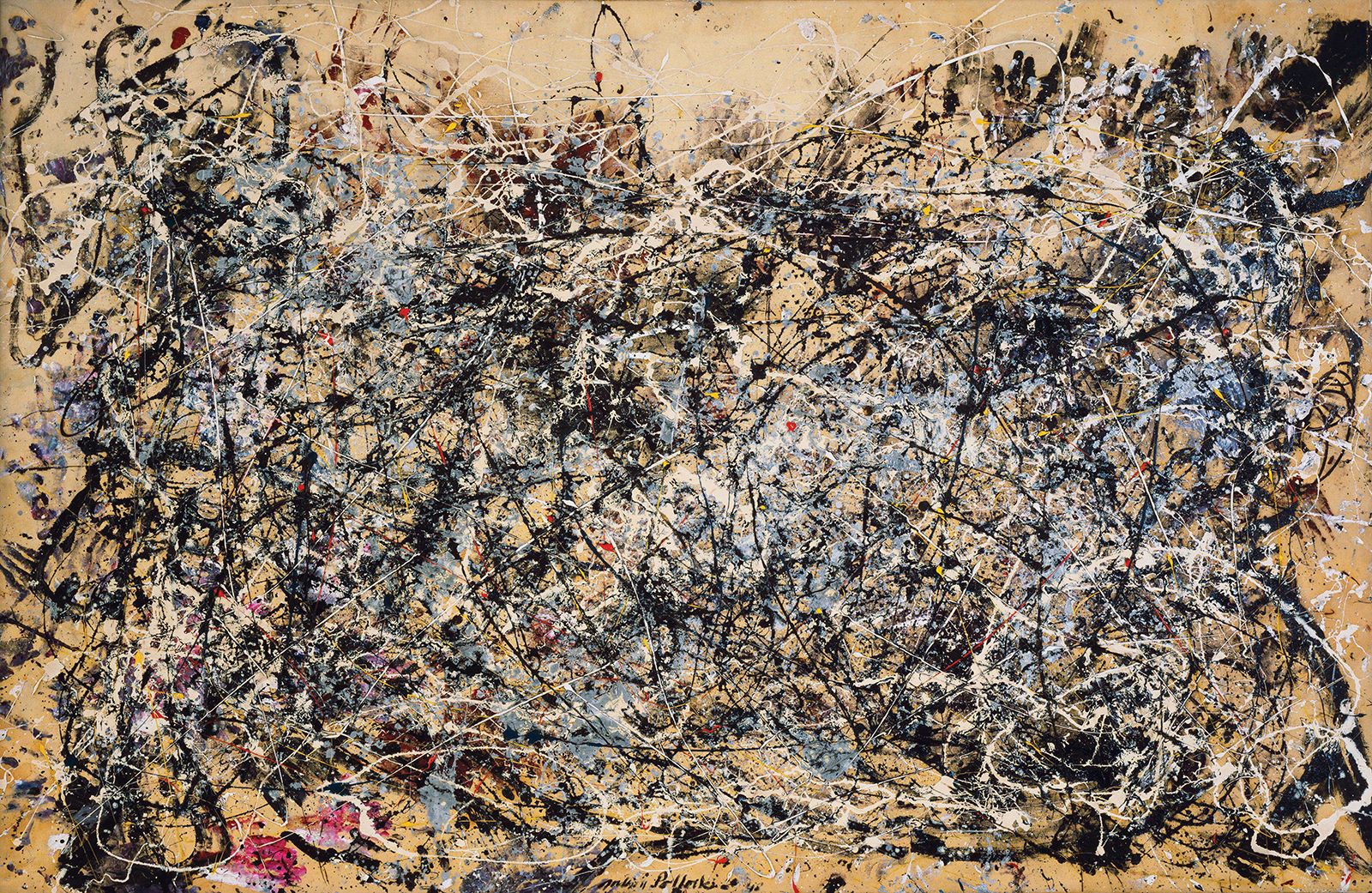
Here’s one more analogy from visual art: each brush stroke of a Jackson Pollock seems random until you contextualize it. If I told you I just knocked over some paint cans and by chance it produced this giant mess it would lose it’s intentionality, it would be rendered shallow. Effort and intentionality are independent variables. A given Jackson Pollock may be considered a “low-effort” painting, but there is no denying that it was immensely impactful because of the intention the artist poured into it, at the time they did it. This is what resonates!
If anything AI-music has underscored the following question for me and fellow musicians. On your lifelong quest of making music: what are you trying to say?
Notes
- AI here referring to generative LLMs in making music à la Suno
- There is an issue with thinking that ethics in music do not matter. This is the relationship between virtue, character and ethics. As in many worthwhile human pursuits, musicians emerse in an ethical framework for the affect it will have on their character and the richness it adds to their musical pallet. For them to become “more fully human”. This is an idea Jonathan Pageau talked about with respect to humanity and technology.
- Communcation can be self-communication, but a self-relation is still a relation. I think some old Danish guy said something like that.
Hi, I'm Jean-Louis Leysens. I like writing software and listening to noisey music.